It’s Up To You… No Really, It’s Up to You: Radiohead, Big Music, and the Future of the Record Industry

deWaard, Andrew. “It’s Up To You… No Really, It’s Up to You: Radiohead, Big Music, and the Future of the Record Industry.” The Business of Entertainment: Popular Music. Ed. Robert C. Sickels. Westport, Conn: Praeger Publishers, 2008. [full text pdf] [world cat] [publisher's website] [amazon]

Abstract: In October of 2007, Radiohead self-released their latest album, In Rainbows, bypassing the corporate record industry and its major label dominance, allowing fans to download the album in mp3 format for whatever price each consumer felt appropriate.  When one logged on to InRainbows.com to download the album, instead of a price at the checkout basket, there was a box to fill-in with a question mark beside it.  Clicking on the question mark prompted a message: “It’s Up To You.”  Clicking again refreshed the screen: “No Really, It’s Up To You.”  This choice included zero dollars, if one was so inclined.  A highly publicized event, the press was quick to comment that this was the first major album whose price was determined by the consumer, but might it be the first major commodity whose price is determined by the consumer?  This ‘pay-what-you-want’ experiment, then, was not just about the changing nature of a music industry in crisis, but of late capitalism itself, of our conceptions of commodity value, labour, and intellectual property in the digital age.  If we accept Jacques Attali’s thesis that music is prophetic, and that every major social rupture has been preceded by a mutation in the codes, audition and economy of music, then what is our current system of music telling us about our future?  By putting the onus of value on the consumer, Radiohead allowed the public to vote for an alternative vision of society by way of, increasingly and unfortunately, the only method available: the consumer dollar.  The shifting terrain of popular culture and the entertainment market, especially the music industry and its forthcoming ‘celestial jukebox,’ is analyzed from the perspective of Radiohead’s symbolic act, with an eye toward the digital revolution’s role in music’s long history of social upheaval.

Posted in publications | Leave a comment

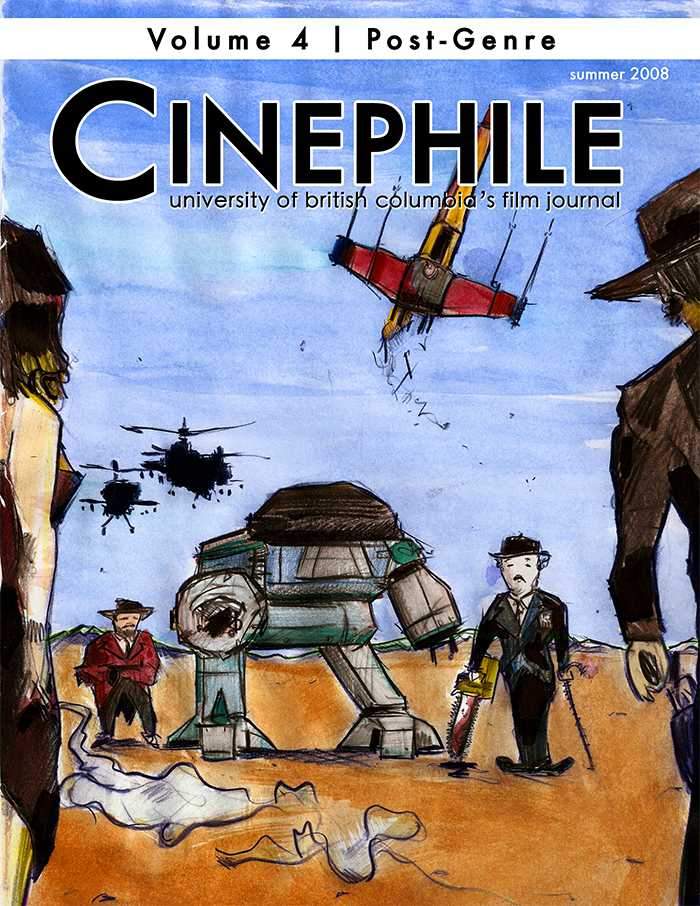
Cinephile Vol. 4, No. 1: Post-Genre

Cinephile is the scholarly film journal published in print and online by the graduate students in Film Studies at the University of British Columbia.  I was the Editor-in-Chief this year, and am immensely proud of the issue our team put together.  The theme we chose was ‘Post-Genre‘:

Genre may be an easy or convenient starting point for analysis and interpretation, but how much does it really matter anymore? Maybe the core film genres have just been around too long; they’ve been maimed and manipulated to such a degree that they no longer resemble their ‘original’ self in any substantial way… We can’t really leave genre behind anymore than we can abandon modernism or industry or structuralism – we’ve just mutated it to the point that it somehow feels new or different. Maybe we should start thinking ‘post’ as less of a temporal marker and more like computational logic. Let’s think of it as an upgrade: Genre 2.0, based on the same fundamental hardware, but with such forward-thinking software that it hardly warrants comparison.

Continue reading Editor’s Note

The issue starts with Susan Ingram’s Cosmotrash: A New Genre for a New Europe, followed by a look at so-called ‘torture porn’ in Gorno: Violence, Shock and Comedy.  Barry Keith Grant was generous enough to share an excerpt from his forthcoming book Shadows of a Doubt: The Fallacy of the Crisis of Masculinity, while other essays consider Irreversible, A Cinema of Cruelty, Cinema from Attractions, The Wire, and The HBO-ification of Genre.  My own essay is also included, entitled The Geography of Melodrama, The Melodrama of Geography: The ’Hood Film’s Spatial Pathos.

Posted in publications | Tagged , , , | Leave a comment