Posts tagged Cinephile

Cinephile Vol. 5, No. 2: The Scene

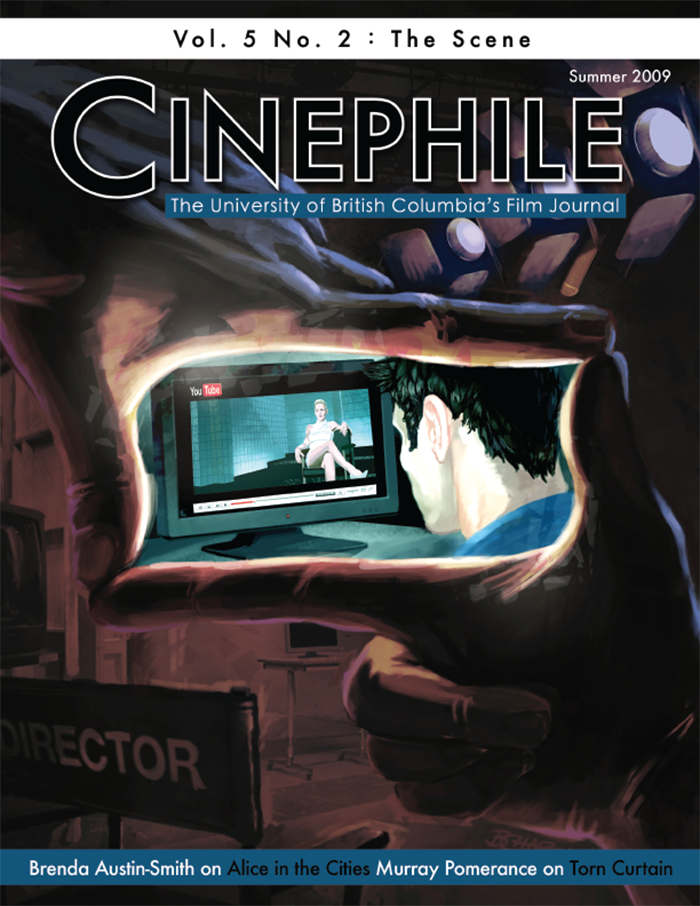
The latest issue of our film journal, Cinephile, is out now — the theme is ‘The Scene’.

There are certain scenes which have the power to enthral, provoke, and delight—our cover captures one such titillating tableau. But what gives such a scene the ability to stand apart, to take on a life of its own? What is it about Robert De Niro’s “Are you talking to me?” scene that has such lasting cultural resonance? How does Gene Kelly dancing in the rain embody an entire ethos of escapism?

Continue reading the Editor’s Note

Each essay in this issue focuses on a single scene, and an embedded video clip of the scene under analysis is included.  Brenda Austin-Smith looks at Alice in the Cities, Murray Pomerance considers Hitchcock’s Torn Curtain, and Elena del Río includes her own short film in the Forward to the issue: What a Scene Can Do,  Other essays look at the Snuff Coda, Eastern Promises, That 70s Sequence, the Post-Mortem Western, and Joy Division and the Televised Performance Scene.

I was the web and layout editor once again, as well as a member of the editorial board.

Cinephile Vol. 5, No 1:
Far From Hollywood, Alternative World Cinema

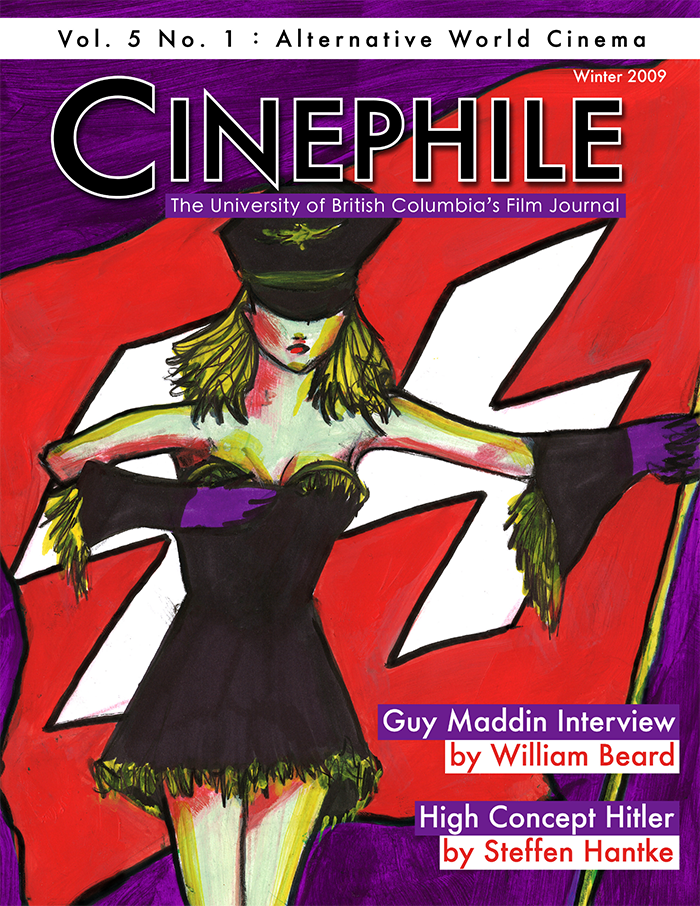
Cinephile has released its latest issue: ‘Far From Hollywood’ – Alternative World Cinema:

…in this, our 5th anniversary issue, we set out to navigate the murky and uncharted depths of ‘alternative cinema’. But carving out an epistemology of this amorphous cinema is no small endeavour-and what do we mean by ‘alternative cinema’ anyway? On the one hand, it is always evolving, always repositioning itself outside mainstream modes of representation: once the mainstream appropriates elements of alternative style, new configurations naturally spring up in response. At the same time, it has no singular mandate, no fixed ideological underpinnings, and is beholden to no specific national cinema or film movement.

Continue reading the Editor’s Note

Steffen Hantke on Hitler as Actor, Jerry White on From Ingushetia to the Finland Station, William Beard’s interview with Guy Maddin, and more, including Holocaust Exploitation, Post-Soviet Freakonomics, and Cinematic Prosthesis.

I was the web and layout editor, as well as a member of the editorial board.

Tom LeClair’s Passing Trilogy: Recovering Adventure in the Age of Post-Genre

Steffen Hantke has quoted me in his essay entitled Tom LeClair’s Passing Trilogy: Recovering Adventure in the Age of Post-Genre, for Electronic Book Review.  With the adventure genre having largely given way to the thriller in popular culture, and the distinct lack of adventure narratives in contemporary literature, Hantke looks at how LeClair’s brazen and ‘adventurous’ use of literary genres in his Passing Trilogy, employing both narrative and temporal deconstruction, negotiates a post-imperial world in which “postcolonial thought, in its widespread effects on contemporary Western culture, has thoroughly discredited the adventurer.”  Hantke concludes his essay by considering my thoughts on ‘Post-Genre’ in the Editor’s Note I wrote for Cinephile Vol 4.1.

Much has been made in recent years of the death of genre, or at least its gradual weakening. Post-genre is the buzzword. Pointing out “Hollywood’s propensity for generic hybridity and overlap in his discussion of the action adventure film, Steve Neale makes the case that cinematic genres have started to move massively away from single distinct genres since the 1980s and ’90s (71) and toward a new polygeneric narrative that seems to transcend all inherited boundaries. This means that, by implication, there must have been an earlier period in which genres used to be, at least relatively speaking, distinct. In the Editor’s Note to a recent issue of Cinephile, Andrew deWaard suggests to read the sense of “perpetual aftermath” that dominates contemporary conceptions of genre not as a sign of its imminent demise but as an invitation for reconceptualization:

We can’t really leave genre behind anymore than we can abandon modernism or industry or structuralism – we’ve just mutated it to the point that it somehow feels new or different. Maybe we should start thinking ‘post’ as less of a temporal marker and more like computational logic. Let’s think of it as an upgrade: Genre 2.0, based on the same fundamental hardware, but with such forward-thinking software that it hardly warrants comparison. (2)

Tom LeClair’s approach to, and use of, genre in the Passing trilogy falls squarely into this model of what one might call “post-genre” for literary fiction. The hardware, as deWaard calls it, is still there, even though the software has been upgraded – to call it “forward-thinking” feels right as well. Readers are supposed to recognize the machinations of genre at work; the writing is intertextual enough, though never obtrusively so, to evoke the history of literary and cinematic adventure. The polygenericity of the trilogy, articulated as a series of shifts from one genre to another, does not undermine the validity of each single genre; instead, it follows an experimental logic. In his exploration of adventure, LeClair “tries out” genres; his moving on to the next is never a dismissal of the previous one. He is not out to abolish genres; does not exploit, consume, or use them up.

Hantke goes on to note that LeClair does not engage in satire, irony or pastiche — typical markers of postmodern genre play — before concluding his essay:

If the Passing trilogy is never patronizing or dismissive of adventure, it is an expression of LeClair’s generosity as a writer, as well as of the skill with which he sustains the tone in all three novels. But, more importantly, it is an expression of his recognition that adventure, as deWaard points out, is an enduring trope in Western culture. If it is simply not an option just to “leave it behind,” then to criticize it makes most sense if the critique is constructive. Adventure may be maligned as politically untenable, as escapism for the immature or uneducated; its hyperbolic pace and near-mythical iconography may seem absurd in a world of bourgeois security and moderation. But then, time and again, the reports of adventure’s imminent death have been greatly exaggerated. It deserves to be taken seriously because there is a place for adventure even in a culture that tells itself that there isn’t. What this place might be, Tom LeClair’s trilogy helps us to understand and imagine.

When I wrote that Editor’s Note, I was only really considering cinematic genre, so I appreciate Hantke applying my thoughts to literary genre as well.  After all, the use of polygeneric narrative can be seen as something of a journey, the author taking the reader on a metatextual ride through a history of iconography, myth and archetype; adventure is a fitting study for this brave new generic world.

Cinephile Vol. 4, No. 1: Post-Genre

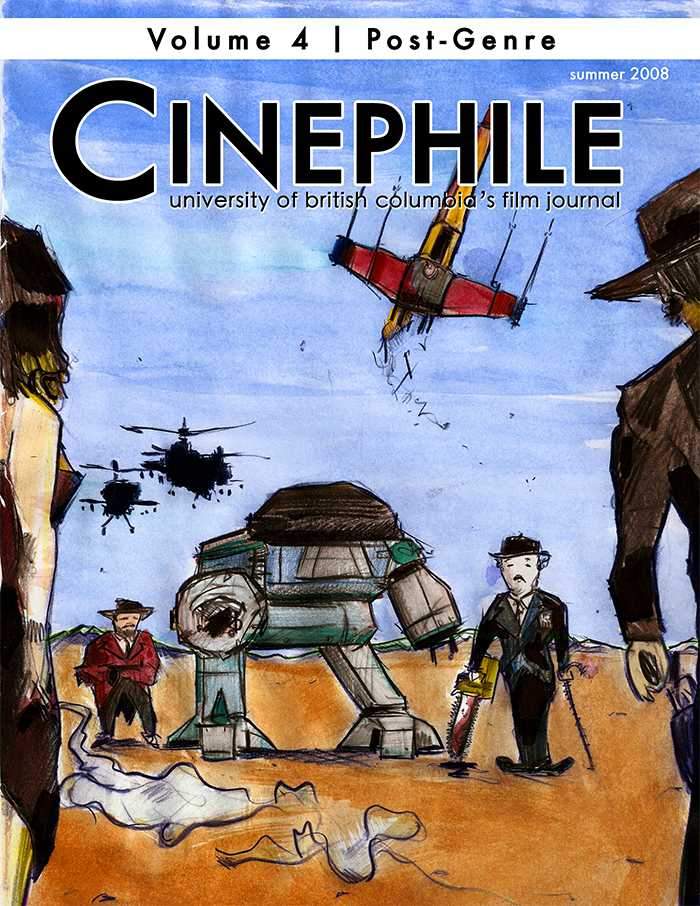
Cinephile is the scholarly film journal published in print and online by the graduate students in Film Studies at the University of British Columbia.  I was the Editor-in-Chief this year, and am immensely proud of the issue our team put together.  The theme we chose was ‘Post-Genre‘:

Genre may be an easy or convenient starting point for analysis and interpretation, but how much does it really matter anymore? Maybe the core film genres have just been around too long; they’ve been maimed and manipulated to such a degree that they no longer resemble their ‘original’ self in any substantial way… We can’t really leave genre behind anymore than we can abandon modernism or industry or structuralism – we’ve just mutated it to the point that it somehow feels new or different. Maybe we should start thinking ‘post’ as less of a temporal marker and more like computational logic. Let’s think of it as an upgrade: Genre 2.0, based on the same fundamental hardware, but with such forward-thinking software that it hardly warrants comparison.

Continue reading Editor’s Note

The issue starts with Susan Ingram’s Cosmotrash: A New Genre for a New Europe, followed by a look at so-called ‘torture porn’ in Gorno: Violence, Shock and Comedy.  Barry Keith Grant was generous enough to share an excerpt from his forthcoming book Shadows of a Doubt: The Fallacy of the Crisis of Masculinity, while other essays consider Irreversible, A Cinema of Cruelty, Cinema from Attractions, The Wire, and The HBO-ification of Genre.  My own essay is also included, entitled The Geography of Melodrama, The Melodrama of Geography: The ’Hood Film’s Spatial Pathos.